

Organic Pest Control for Vegetable Gardens: A Regenerative Guide
Summary
Organic pest control for vegetable gardens starts with one question: why are the pests here? On our less-than-an-acre homestead in North Carolina (Zone 8A), we grow our food without synthetic pesticides, herbicides, or fertilizers. Instead, we rely on healthy soil, biodiversity, and the beneficial insects that do most of the work for us.

- Organic Pest Control for Vegetable Gardens: A Regenerative Guide - November 4, 2026
- Free Garden Planner PDF: Start Planning Your Dream Garden - November 4, 2026
- Heirloom Gardening for Beginners: 15 Easy Heirloom Vegetables + How to Save Seeds - October 30, 2026

This post may contain affiliate links, which means I can receive a commission from any purchase made from the links. I earn from purchases from Amazon links. See the disclosure policy here.
Quick answer: The most effective organic pest control combines healthy soil, diverse plantings, beneficial insects, crop rotation, insect netting, and hand removal. Insecticides are a last resort.
A Regenerative Approach to Organic Pest Control in Vegetable Gardens
Your vegetable garden is a living, breathing ecosystem of insects, birds, amphibians, and countless other living organisms.
When we discover holes in our tomato leaves or aphids covering our plants, our first instinct is often to find something that will kill the pests. But regenerative gardening encourages us to look at the bigger picture.
Why are these insects here? What is keeping their natural predators away? Are our plants struggling because of poor soil, environmental stress, or a lack of biodiversity?
The best organic pest control starts with understanding your garden as an ecosystem, not a collection of individual plants.
Regenerative gardeners try not to rely on insecticides. We build healthy soil, encourage beneficial insects, and diversify our plantings to create balance in the garden.
This doesn’t mean pests will disappear. It means learning how to manage them without disrupting the very ecosystem we’re trying to grow.
What Is Organic Pest Control in Regenerative Gardening?
Organic pest control involves managing harmful insects and other garden pests using practices that support soil health, biodiversity, and ecological balance.
Regenerative gardening takes this approach further by focusing on the relationships between plants, soil organisms, insects, and wildlife.
Rather than treating every pest as a problem to eliminate, we look for ways to strengthen the entire growing system.
The foundation of regenerative pest management includes:
- Building healthy, biologically active soil.
- Growing a diverse combination of vegetables, herbs, flowers, and perennial plants.
- Attracting and protecting beneficial insects.
- Providing habitats for birds, amphibians, reptiles, and other natural predators.
- Using companion planting and crop rotation.
- Protecting vulnerable crops with physical barriers.
- Removing destructive pests by hand when necessary.
- Allowing natural predator-prey relationships to develop.
These practices work together to create a more resilient garden.
A healthy ecosystem will not prevent every pest outbreak, but it can reduce the need for intervention and help plants recover from occasional damage.
Identify Garden Pests Before Taking Action
One of the most important lessons I’ve learned in gardening is that not every insect is an enemy.
Some insects eat plants, some eat other insects, and many do a little of both during different stages of their lives.
Before removing anything from your garden, identify what you’re looking at.
For example, ladybug larvae look nothing like adult ladybugs. Their dark, elongated bodies can look threatening, but they are excellent predators of aphids.
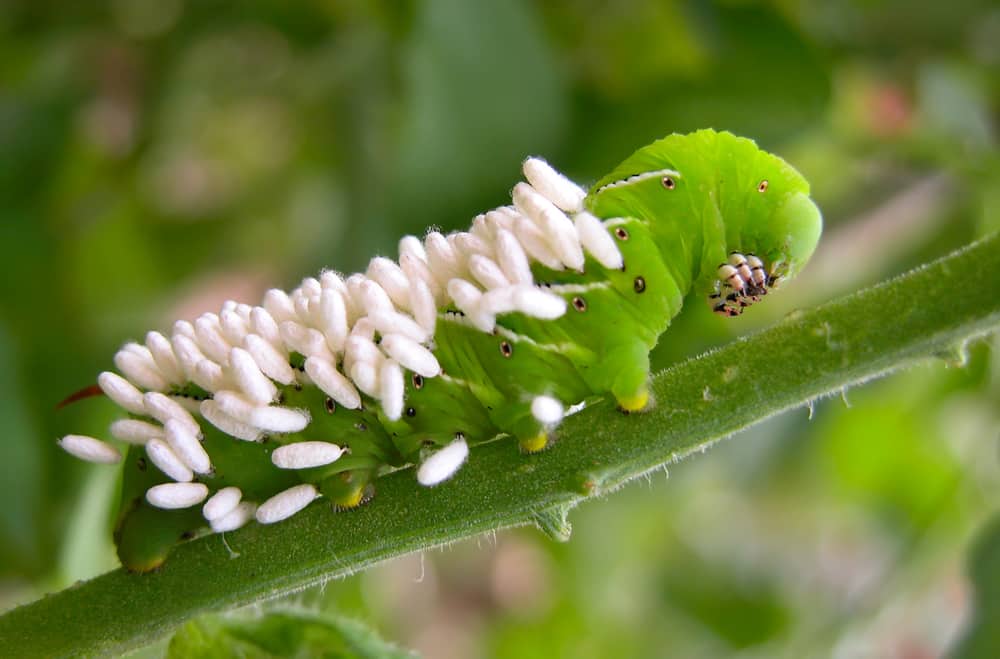
Similarly, a tomato hornworm covered in small white cocoons may look like a serious problem, but it is already hosting the next generation of parasitic wasps.
Understanding these relationships helps us make better decisions.
Common Vegetable Garden Pests
| Garden Pest | Common Signs | Regenerative Management |
| Aphids | Clusters on new growth, curled leaves | Encourage ladybugs, lacewings, and hoverflies; rinse small colonies with water |
| Tomato hornworms | Missing tomato foliage, dark droppings | Handpick non-parasitized caterpillars; protect parasitic wasps |
| Cabbage worms | Holes in cabbage, kale, and broccoli | Use insect netting and hand removal |
| Slugs and snails | Irregular holes, damaged seedlings | Handpick, manage damp hiding places, protect seedlings |
| Japanese beetles | Skeletonized leaves | Remove adults by hand, especially early in the morning |
| Squash bugs | Wilting foliage, bronze-colored egg clusters | Remove eggs, handpick adults, protect young plants |
| Colorado potato beetles | Damaged potato foliage, orange egg clusters | Rotate crops, remove eggs and larvae |
| Whiteflies | Small white insects, sticky leaves | Encourage natural predators, remove heavily infested foliage |
| Spider mites | Fine webbing and stippled leaves | Reduce plant stress, rinse affected foliage, support predatory mites |
| Cutworms | Seedlings severed near the soil surface | Use protective seedling collars and inspect the soil |
Not every damaged leaf requires intervention.
A mature, healthy plant can often tolerate some feeding without significantly affecting its harvest.
The goal is to recognize when pest populations are becoming destructive and respond with the least disruptive method available.
Garden Tip: Use iNaturalist to identify unfamiliar insects before removing them. You may discover that the creature you’re about to eliminate is actually helping your garden.
Build Healthy Soil to Support Natural Pest Resistance
Regenerative pest control begins beneath our feet.
Healthy soil supports the roots, microorganisms, fungi, and other organisms responsible for nutrient cycling and plant growth.
When soil is compacted, depleted, or biologically inactive, plants may struggle to access the water and nutrients they need.
Stressed plants can become more vulnerable to certain pests, although healthy soil alone cannot prevent insect damage.
Building soil health is one of the most important long-term investments we can make in our gardens.
Feed the Soil, Not Just the Plants
Instead of relying on repeated applications of soluble fertilizers, regenerative gardeners focus on maintaining organic matter and supporting soil biology.
Some of my favorite practices include adding finished compost, using appropriate aged animal manures, growing cover crops, and returning plant material to the soil.
Compost provides organic matter and nutrients while supporting soil structure and microbial activity.
Properly composted manure can also contribute nutrients, but use safe handling and application practices when growing edible crops.
Avoid excessive nitrogen applications, which can encourage tender growth that attracts some sap-feeding insects.
Keep Your Soil Covered
Bare soil is vulnerable to erosion, moisture loss, temperature fluctuations, and weed establishment.
Mulching protects the soil surface and creates more stable growing conditions.
Organic mulch options include:
- Shredded leaves
- Straw
- Untreated grass clippings
- Finished compost
- Chopped cover crop residue
- Other appropriate plant materials
As these materials break down, they contribute organic matter to the soil.
Mulch can also provide shelter for ground beetles, spiders, and other organisms that feed on garden pests.
However, thick, damp mulch may shelter slugs. If slugs become a problem, pull mulch away from vulnerable seedlings and reduce excessively moist hiding places.
Learn more about mulching a vegetable garden.
Minimize Soil Disturbance
Frequent tilling disrupts soil structure, fungal networks, earthworm habitats, and other biological relationships.
Reducing unnecessary disturbance helps preserve the environment where soil organisms live.
No-till and low-till gardening also allow organic matter to accumulate near the soil surface.
You can explore more ways to improve garden soil organically.
Encourage Beneficial Insects Instead of Eliminating Pests
A regenerative garden needs insects. Even insects that damage crops serve as food for predators and parasitoids.
When we eliminate every aphid or caterpillar, we also remove food sources that help support beneficial populations.
This doesn’t mean allowing destructive infestations to continue unchecked. It means understanding that some pest activity is part of a functioning ecosystem.
Ladybugs
Ladybugs are among the most recognizable beneficial insects. Both adults and larvae feed on aphids and certain other soft-bodied pests.
Instead of purchasing ladybugs, I prefer to create conditions that encourage local populations to establish themselves.
Flowering herbs, diverse plantings, and reduced pesticide use can help support them.
Lacewings and Hoverflies
Lacewing larvae effectively prey on aphids, mites, and other small insects.
Hoverfly larvae also feed on aphids, while adults visit flowers for nectar and pollen.
Planting sweet alyssum, dill, cilantro, and other small-flowered plants provides resources for these beneficial insects.
Parasitic Wasps
Parasitic wasps are some of the most fascinating natural pest-control organisms in the garden.
Many species are tiny and harmless to people.
They lay eggs in or on other insects, and their developing young eventually kill the host.
One of my favorite examples is the relationship between tomato hornworms and braconid wasps.
I once found a hornworm on my tomatoes that had already been parasitized. Instead of removing it, I left it for the wasps to finish their work.
Those small white structures attached to a parasitized hornworm are typically wasp cocoons.
Allowing the wasps to emerge helps support another generation of natural predators.
Ground Beetles and Spiders
Ground beetles are often overlooked because many are active at night.
Depending on the species, they feed on caterpillars, insect eggs, slugs, and other invertebrates.
Spiders also help regulate insect populations.
Leaving some undisturbed habitat, maintaining organic mulch where appropriate, and reducing unnecessary pesticide applications can help support these predators.
Welcome Wildlife Into Your Garden
Insects aren’t the only creatures that maintain ecological balance.
Birds, frogs, toads, salamanders, lizards, and snakes all contribute to garden food webs.
I love finding a Dekay’s brown snake moving through my garden. These small, harmless snakes feed primarily on soft-bodied invertebrates, including slugs and earthworms.
They remind us that a healthy garden supports much more than vegetables.

Create Habitat for Natural Predators
You can encourage wildlife by providing:
- Native flowering plants.
- Shrubs and hedgerows for shelter.
- Leaf litter and undisturbed habitat areas.
- Shallow water sources that you clean regularly.
- Logs, stones, and other natural hiding places.
- A variety of plants that flower throughout the growing season.
Avoid using pesticides around wildlife habitats.
Also, remember that predators don’t distinguish between organisms we consider beneficial and harmful. Snakes, birds, and other wildlife are part of a larger food web, not pest-control tools that work exclusively in our favor.
The goal is to support biodiversity, not control every interaction.
Companion Planting for Organic Pest Control
Companion planting is one of the easiest ways to introduce biodiversity into a vegetable garden.
Instead of growing large blocks of a single crop, I like to mix vegetables, herbs, flowers, and perennial plants throughout the growing space.
This approach creates a more varied habitat and provides resources for pollinators and beneficial insects.
Some plant combinations may also influence pest behavior, although companion planting does not guarantee protection from insect damage.
The Best Companion Plants for Beneficial Insects
| Plant | Benefits to the Garden Ecosystem |
| Sweet alyssum | Provides nectar for hoverflies and small parasitic wasps |
| Dill | Attracts beneficial insects when allowed to flower |
| Cilantro | Flowers support hoverflies and parasitoids |
| Yarrow | Provides nectar and habitat for beneficial insects |
| Calendula | Adds floral diversity and resources for pollinators |
| Marigolds | Contribute floral diversity; some species have specialized uses in pest management |
| Basil | Flowers attract bees and other beneficial insects |
| Oregano | Flowering plants provide nectar |
| Buckwheat | Rapid-growing flowering cover crop that supports beneficial insects |
| Native flowering plants | Support locally adapted pollinators and natural predators |
The greatest benefit comes from growing a variety of plants that bloom at different times.
This helps provide food and shelter for beneficial insects throughout the growing season.

Companion Planting Around Tomatoes
In my garden, I plant basil, oregano, and marigolds among my tomatoes.
These plants increase diversity and provide flowers that attract beneficial insects.
During one growing season, we discovered only one hornworm, and parasitic wasps had already found it.
While I can’t attribute that result entirely to companion planting, it reinforced my preference for encouraging natural predators.
I would rather create a garden where beneficial insects can thrive than rely on spraying every time I find a pest.
For help planning your planting combinations, explore my Free Garden Planner.
Use Crop Rotation to Interrupt Pest Life Cycles
Crop rotation is an important part of regenerative gardening.
Growing the same crop in the same location year after year can allow certain pests and soilborne pathogens to become established.
Rotating crops helps interrupt some of these cycles.
For example, Colorado potato beetles can overwinter in the soil near their previous host plants.
Moving potatoes to a different part of the garden may reduce pressure, especially when the new planting is far enough from the previous location.
Similarly, rotating tomatoes, peppers, and eggplants can help manage certain problems associated with crops in the nightshade family.
Crop rotation is most effective when combined with other practices, including removing heavily infested plant material and maintaining healthy soil.
In small gardens, limited space may limit rotation. Interplanting, sanitation, resistant varieties, and careful monitoring become especially important.
Grow Cover Crops to Improve Soil and Biodiversity
Cover crops help regenerative gardeners protect and improve soil between growing seasons. They reduce erosion, contribute organic matter, and support soil organisms.
Some flowering cover crops also provide food for beneficial insects.
Cover Crops for Regenerative Vegetable Gardens
| Cover Crop | Primary Benefits |
| Crimson clover | Nitrogen fixation, spring flowers, soil coverage |
| Hairy vetch | Nitrogen fixation and organic matter |
| Buckwheat | Quick soil coverage and nectar for beneficial insects |
| Oats | Organic matter production and erosion control |
| Cereal rye | Winter soil protection and weed suppression |
| Red clover | Nitrogen fixation and long-term soil coverage |
| Sorghum-sudangrass | Biomass production and soil improvement |
Select cover crops based on your climate, planting schedule, and available space.
Some species can become difficult to manage if allowed to produce mature seed.
Chop and Drop Mulching
Chop and drop is another regenerative practice that returns plant material directly to the soil.
Instead of removing all plant residue, you cut appropriate plants and leave the material on the soil surface to decompose.
You can use comfrey, buckwheat, and other biomass-producing plants this way.
As the material decomposes, it contributes organic matter and helps protect the soil.
Avoid leaving heavily diseased or pest-infested material in areas where it may contribute to future problems.
Physical Pest Control Without Insecticides
Sometimes natural predators need a little help.
Physical pest-control methods allow us to protect crops without introducing insecticidal substances into the garden.
Handpick Destructive Insects
Hand removal is one of the simplest organic pest-control methods.
I regularly inspect my vegetables for hornworms, squash bugs, and other larger pests.
Tomato hornworms are particularly difficult to spot because their green bodies blend into the foliage.
One trick is to take a black light into the garden after dark. Hornworms can fluoresce under ultraviolet light, making them easier to locate.
When I find a hornworm that hasn’t been parasitized, I remove it from the plant.
If it is covered in parasitic wasp cocoons, I leave it when practical.
Protect Crops With Insect Netting
Insect netting and floating row covers create physical barriers between crops and pests.
They are especially useful for protecting:
- Cabbage, broccoli, and kale from cabbage butterflies.
- Young brassicas from flea beetles.
- Carrots from carrot rust flies.
- Young cucurbits from cucumber beetles.
Install barriers before pests arrive and secure the edges.
For crops that depend on insect pollination, remove or adjust the covers during flowering unless another pollination method is provided.
Remove Insect Eggs
Squash bugs and Colorado potato beetles lay eggs on plant leaves.
Checking the undersides of foliage and removing egg clusters can prevent larger populations from developing.
Regular garden observation is often more effective than waiting until damage becomes severe.
Use Water to Remove Aphids
A strong but controlled spray of water can dislodge aphids from sturdy plants.
Focus on affected stems and the undersides of leaves, avoiding tender growth.
You may need to repeat this method, but it avoids the broad effects of insecticides.
Before spraying, check for ladybug larvae and other predators already feeding on the aphids.
Homemade Castile Soap Spray for Garden Pests
Even in a well-balanced garden, pest populations may grow faster than natural predators can manage.
For small infestations of soft-bodied insects, some gardeners use a diluted Castile soap spray as a last resort.
Pure Castile soap is made from vegetable oils rather than synthetic detergents. However, homemade mixtures are not standardized or tested like commercial insecticidal soaps, and they can damage plants or harm beneficial insects.
I prefer to begin with water sprays, hand removal, and natural predators. If those methods aren’t enough, you may consider a carefully tested soap mixture, with the understanding that its safety and effectiveness are uncertain.
Simple Castile Soap Spray Recipe
Ingredients:
- 1 teaspoon of unscented, pure liquid Castile soap
- 1 quart (32 ounces) of water
Instructions:
- Add the water to a clean spray bottle.
- Add the Castile soap and shake gently to combine.
- Test the mixture on a small section of the affected plant.
- Wait 24–48 hours and check for discoloration, wilting, or leaf damage.
- If no damage appears, lightly spray the affected insects, including those on the undersides of leaves.
- Rinse treated foliage with clean water after a short contact period to reduce the risk of soap injury.
Important Precautions
- Use only when necessary and on a limited number of affected plants.
- Avoid spraying in hot weather or on drought-stressed plants.
- Do not spray open flowers or beneficial insects.
- Avoid adding essential oils, vinegar, or other ingredients.
- Stop using the mixture if foliage shows signs of damage.
- Do not assume the mixture is approved for certified organic production.
Homemade Castile soap sprays are not registered pesticides and have not been evaluated for use on every edible crop. A commercial insecticidal soap labeled for the crop and pest, and permitted under applicable organic standards, may be the more reliable option when treatment is necessary.
Remember: Regenerative pest control is about using the least disruptive method that effectively protects your plants, not eliminating every insect in the garden.
Do Organic and Regenerative Gardens Need Insecticides?
An established regenerative garden may require fewer pesticide applications, but no gardening method can guarantee that serious pest outbreaks will never occur.
Weather conditions, invasive species, crop susceptibility, and other factors can sometimes overwhelm natural controls.
Organic production standards permit certain pesticides under specific conditions, but regenerative gardening emphasizes prevention and ecological function.
I prefer to avoid insecticides whenever practical.
Even naturally derived products such as neem oil, pyrethrins, and diatomaceous earth can affect organisms beyond the intended pests.
For example:
- Neem-based insecticides may harm non-target insects through direct exposure.
- Diatomaceous earth can injure beneficial insects as well as pests.
- Pyrethrins, although derived from chrysanthemums, are broad-spectrum insecticides that can kill beneficial insects.
A substance being natural does not automatically make it harmless to the garden ecosystem.
For gardeners who choose an organic pesticide when other methods are insufficient, the product should be labeled for the crop and pest, applied according to instructions, and selected to minimize harm to non-target organisms.
The objective should always be to use the least disruptive effective intervention.
Design a Garden That Supports Natural Pest Control
Regenerative gardening becomes easier when we intentionally design spaces that support biodiversity.
Instead of thinking about the vegetable garden as a collection of separate beds, consider how the surrounding landscape influences what happens inside them.
A nearby hedgerow may provide shelter for birds and predatory insects. Flowering borders can offer nectar and pollen throughout the growing season. Perennial herbs and ground covers create additional habitat.
Trees and shrubs contribute leaf litter, shade, and organic matter while supporting a wide variety of wildlife.
Include Multiple Layers of Vegetation
A diverse garden can include:
- Canopy plants: Fruit trees and other appropriate trees that provide habitat and influence microclimates.
- Shrubs: Berry bushes, native shrubs, and flowering hedgerows.
- Herbaceous plants: Vegetables, perennial herbs, and flowering plants.
- Ground covers: Low-growing plants that protect the soil.
- Root crops: Plants occupying different portions of the soil profile.
- Climbing plants: Vines that make use of vertical growing space.
Not every garden needs every layer.
Even a small backyard vegetable garden can benefit from a few perennial flowers, herbs, shrubs, and undisturbed habitat areas.
The goal is to create a growing space that supports more life and requires fewer outside inputs over time.

Frequently Asked Questions About Organic Pest Control
The best approach combines healthy soil, biodiversity, companion planting, beneficial insects, crop rotation, and physical pest management.
No single method controls every pest. A combination of preventive practices creates a more resilient growing system.
Use insect netting to protect vulnerable crops, inspect plants regularly, remove destructive insects by hand, and encourage natural predators.
You don’t need to eliminate every insect. Many are essential to pollination, decomposition, and pest regulation.
Companion planting can support beneficial insects and sometimes reduce pest pressure, depending on the crops and insects involved.
It works best when combined with other regenerative gardening practices.
Ladybugs, lacewings, hoverflies, parasitic wasps, ground beetles, and many spiders can help regulate pest populations.
Providing flowering plants, shelter, and reduced pesticide exposure encourages these organisms to remain in your garden.
Healthy soil supports strong plant growth and can improve a plant’s ability to tolerate stress.
However, soil health alone cannot prevent every pest infestation.
It is one part of a broader ecological approach to pest management.
Yes. Many home gardeners successfully grow vegetables using physical barriers, hand removal, beneficial insects, crop rotation, and other preventive practices.
Results depend on local pest pressure, crop selection, climate, and garden management.
Create a Garden That Works With Nature
The longer I garden, the more I realize that nature already has systems in place to manage many of the problems we encounter.
Ladybugs feed on aphids. Parasitic wasps find hornworms. Spiders capture insects among the plants, and birds and amphibians contribute to the garden’s food web.
Beneath the soil, microorganisms break down organic matter and help cycle nutrients that support plant growth.
Every organism has a role, even when we don’t immediately understand it. Regenerative gardening teaches us to observe these relationships before intervening.
When we improve soil health, diversify our plantings, protect beneficial insects, and create wildlife habitats, we begin building a garden that can regulate many of its own problems. That doesn’t mean we’ll never lose a plant to insects or have to remove a destructive pest.
It means we can approach those challenges without disrupting everything else we’ve worked to establish.
The best organic pest control isn’t about eliminating life from the garden. It’s about creating the conditions for life to thrive in balance.

Learn More About Natural and Regenerative Gardening
Organic pest control is just one part of creating a healthy, thriving garden ecosystem. When we begin to understand how soil, plants, insects, and wildlife work together, we can design gardens that become more resilient, productive, and self-sustaining over time.
In my book, How to Create a Thriving Garden Ecosystem, I take you beyond individual gardening techniques and explore how to build a regenerative garden from the ground up. You’ll learn how to observe your landscape, improve soil health, encourage biodiversity, and design a growing space that works with nature rather than against it.
Whether you’re starting your first vegetable garden or transforming an existing one, this book will help you see your garden as a living ecosystem and make more intentional decisions about how you grow.
START BUILDING A MORE RESILIENT GARDEN
The Regenerative Garden Roadmap
Not sure where to begin with regenerative gardening?
This free roadmap breaks the process into five simple building blocks so you can focus on the changes that create the biggest impact.
Here’s What You Get:
Regenerative Gardening Roadmap PDF – Garden Assessment Worksheet – Priority Action Plan – Regenerative Gardening Checklist – Ecosystem Planning Worksheet


